Took a bit of a break the last few weeks, but just couldn’t ignore all the great things the Claude team has been building.
I still prefer GPT codex models because it just works, makes far fewer mistakes, and I find the planning to be far more accurate. It feels like working alongside another senior engineer who pushes back. One thing that sums it all up is this screenshot, codex is all business and here to get work done.
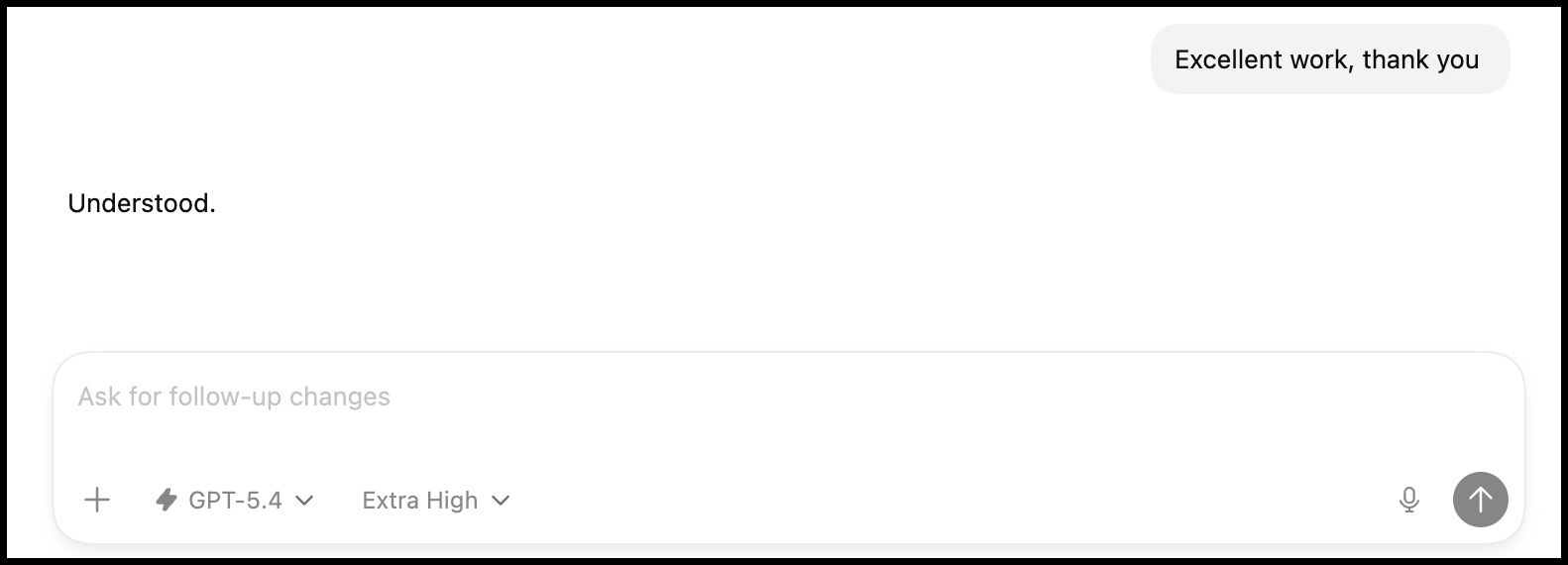
What’s cool since this time is more and more features have shipped to have AI agents are looking less like tools and more like systems that grow with you. I love this pattern and really gets me excited about this space.
This week I wanted to highlight a paper on self-improving agents, a plugin that compounds your knowledge, and a feature that lets you supervise your Claude agent from your phone. Let’s get into it.
Anthropic is shipping like crazy
The Anthropic team has been taking every Openclaw primitive and been incorporating it into Claude. I think this is great for building more agent-ready help outside of tinkering with Openclaw. See this crazy chart below on just how much they’ve been shipping:
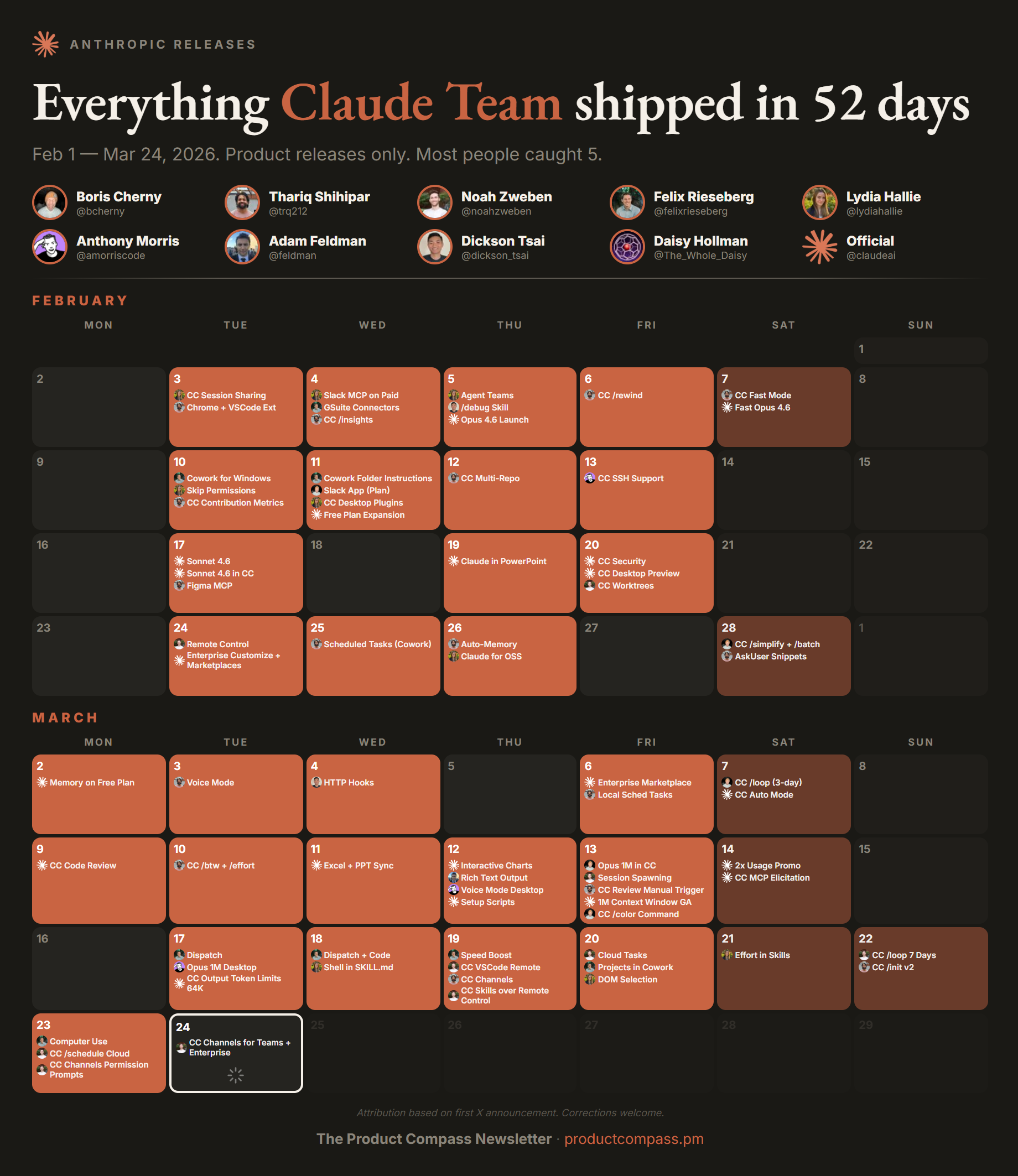
I still will be exploring my own Openclaw setup, but it’s hard to ignore these polished features from the Anthropic team that make having an async agent easier than ever. Maybe our personal assistant Hermy will be getting a Claude makeover soon.
Claude Code Channels: Never easier to have a remote setup.

I texted my Claude Code session from iMessage this week.
Anthropic shipped Channels in Claude Code v2.1.80. It’s a system that lets external platforms push messages into your Claude Code session and get replies back. Telegram. Discord. And yes — iMessage is now enabled. I can’t wait to see this come to all AI tools.
Here’s why this matters: Every serious AI coding workflow hits the same wall: you kick off a task, and then you’re chained to the terminal waiting for it to finish or ask a question. You can fire off work, walk away, and get a Telegram ping when Claude needs permission to run a command. This was the big unlock I loved about my personal Openclaw setup — and now it’s built into Claude.
The iMessage plugin works by reading your local Mac Messages database directly and sending replies through AppleScript. You can allowlist specific contacts by phone number or Apple ID so only you can talk to it. It works over SMS too.
The permission relay is the feature that makes this actually useful for real work. When Claude wants to run a bash command or write a file, it forwards the approval prompt to your chat app. You see exactly what it wants to do and approve or deny from wherever you are. The terminal dialog stays open too and whichever answer arrives first wins.
And the whole thing is built on MCP. Which means anyone can build a channel. The architecture is simple: your channel is an MCP server that Claude Code spawns as a subprocess. It pushes events in, optionally exposes a reply tool for two-way chat, and optionally relays permission prompts. Anthropic published the full spec and working implementations for all of them.
I think this is one of the most important features shipped this month. Not because it’s flashy. Because it solves the actual bottleneck in agentic coding: you can’t babysit the terminal all day. Channels let you supervise from anywhere.
We’re getting closer to the world where your agent is just running. And you check in on it like you’d check in on a coworker.
Channels docs | Official plugins (GitHub)
Compound Knowledge: A Plugin That Makes Your AI Smarter Over Time

I found a plugin this week that nails something I’ve been trying to codify to share myself. How do you make your AI tinkering and work compound instead of starting from zero every time?
The Compound Knowledge plugin from Every gives you a structured loop: brainstorm, plan, confidence check, review, execute, save learnings. That last part is the key. Every time you finish a cycle, you extract what you learned and save it as markdown. Next time you brainstorm or plan, the system automatically searches your past learnings and surfaces what’s relevant.
A knowledge base that grows with every project and learns how you work. that knoweldge is extremely valuable for agents giving you better output.
What I really like is the confidence check. You can call it anytime and the agent gives you an honest breakdown of what it actually understands versus what it’s guessing at. Most people just blindly trust the output. This forces you to see the gaps before you throw tokens at the wall.
The review step is smart too. Two agents run in parallel — one checks strategic alignment, the other checks data accuracy. Results come back prioritized. P1 blocks shipping. P2 you should fix. P3 is nice to have.
Everything saves as plain markdown with YAML frontmatter in a docs/knowledge/ directory. Git-tracked and Searchable. No database. Just files that your agent can find later.
This is exactly the kind of thing I mean when I say skills are the highest-leverage investment right now. Because it means AI is attempting to get better at your specific work every time you use it.
Compound Knowledge Plugin (GitHub)
Hyperagents: AI That Learns How to Learn
Meta dropped a paper this week that we can’t ignore.
It’s called Hyperagents. The basic idea: what if an AI agent could edit its own improvement process? Not just get better at tasks. Get better at getting better.
Most self-improving AI systems have a fixed loop. Try something, evaluate, adjust, repeat like we saw with the Every plugin. The adjustment strategy itself never changes. Hyperagents make that adjustment strategy editable too. It’s self-improvement all the way down.
What’s wild is the improvements transfer. The system figured out better memory management and performance tracking on one domain — then carried those meta-skills into completely different tasks. It learned how to learn, and that knowledge traveled.
I think this matters more than people realize. I think it’s valuable to spend time building skills and instructions for our agents right now. That’s the right move, but papers like this hint at where things are going — agents that don’t need us to write the playbook. They write their own. Then they rewrite it and compress and optimize it.
We’re not there yet. But the gap is closing faster than I expected.
Paper: Hyperagents (arXiv:2603.19461)
The Thread That Connects All of This
Look at what Anthropic shipped in just a few weeks. Channels solve the supervision problem for regular users. You’re not chained to the terminal anymore with Claude code. Compound Knowledge plugin attempts to solve the memory problem so that your agent builds on what it learned last time. And Hyperagents show us the potential endgame, agents that figure out how to improve themselves without you writing the playbook.
I said at the top that I still prefer codex for the actual work right now. That hasn’t changed.
But the ecosystem Anthropic is building around Claude Code is starting to look like something bigger than any single model. Remote supervision from your phone. Knowledge that compounds across sessions. And the open plugin architecture anyone can extend.
I don’t thinks its the right time to go all in on building your own self improving source unless you have time to race the AI labs. I think worth waiting for the next wave of improvements we will see this summer.
The best model matters less every month. The best system around the model matters more. Whether that’s Claude’s ecosystem or Codex’s or something we haven’t seen yet — build your skills, build your infrastructure, and stay ready to move and change your mind.
The agents are getting smarter every week. Make sure you are too.
See you next week.